
UL Solutions: Case Study - WERCSmart Packaging
Regulatory Compliance at Scale
WERCSmart Packaging
Regulatory Compliance at Scale
WERCSmart is UL Solutions’ enterprise product compliance platform, connecting more than 8,000 suppliers with 55+ retailers, including Walmart, CVS, Home Depot, Lowe’s, and Target. Suppliers register products by submitting detailed chemical, safety, and regulatory information, which WERCSmart evaluates against thousands of federal and state regulations before retailers can distribute those products.
In early 2026, UL signed the largest contract the Supply Chain Insights group had closed to date: a $1M, three-year contract with Cardinal Health. The project required WERCSmart to introduce packaging compliance for PFAS (“forever chemicals”), requiring suppliers to report packaging information WERCSmart had never collected before.
Role Product Designer
Timeframe 4 months
Platform Desktop
Deliverables
User workflows
High fidelity annotated wireframes
Tools Miro, Figma
Notes I was the sole product designer on this initiative, new to both WERCSmart and the compliance industry. Before requirements existed, I partnered with the UX research lead to understand the platform, map the current registration experience, and make complex workflows visible. Together, we worked with Product and Engineering to define the MVP and design the packaging experience.

Background
In early 2026, WERCSmart faced an immediate contractual obligation: deliver packaging-related compliance data to Cardinal Health by June 30, specifically to indicate whether packaging contains PFAS and other regulated chemical groups, information that was never collected before.
Product & the larger team did not know where to begin. There were no written requirements or shared interpretation of how the contract's obligations should be implemented. The packaging experience itself wasn’t designed to support the new compliance requirements.
The Real Problem
The challenge wasn't PFAS. It was visualization and definition.
The product owner and manager brought decades of platform knowledge to this project but design had never been part of the process. Product, Regulatory, and Engineering each understood different parts of the system, but the team lacked a shared picture of what needed to be built or how the existing system could support it. The problem had been discussed for months, but without a shared visual representation of it.
My Approach - Design as Diagnosis
That's where I came in. As the sole product designer new to both the platform and the compliance industry, I worked closely with our UX researcher to externalize the knowledge the team already had. By translating years of institutional knowledge and regulatory ambiguity into flows, visuals, and structured decisions, we helped the team see what they already understood and move from abstract discussion to concrete product direction.
Design initially wanted to look through the contract together to pull out what the product team thought it meant to deliver and help break deliverables down that way. However the contract outlined what needed to be achieved - PFAS compliance, without specifying how WERCSmart should support it. This ambiguity required us to first understand the system itself using design not just as a solution, but as a method to define and clarify the problem.
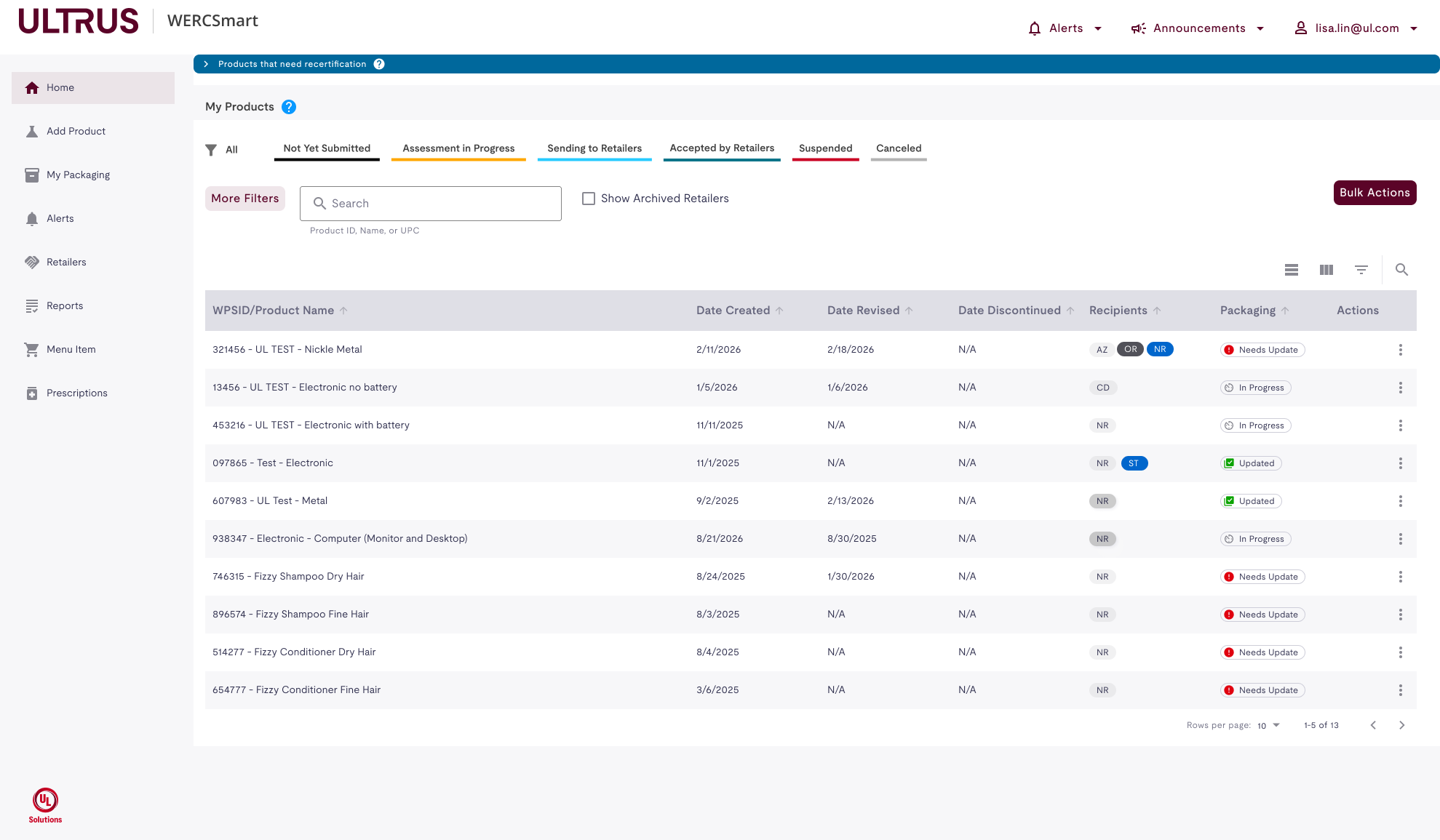
I began by reviewing historical demo videos and deep-dive recordings to trace the origins of WERCSmart, understand how suppliers and retailers interacted with the platform, and map where packaging appeared or didn't in the existing registration flow. My researcher and I each ran our own research in parallel, then came together to share what we'd found. From there, I mapped out the flows and current-state visuals, and we went back and forth refining them, pressure-testing my thinking against her research, and her read against what I was seeing in the flow, until it actually held up. That gave us something concrete to pressure-test in stakeholder meetings, despite our incomplete understanding at the time.
Current state audit: existing WERCSmart registration flow.
The full flow spanned dozens of steps across multiple product types, revealing where complexity and gaps existed.
The next challenge was deciding how suppliers should provide that information without disrupting an already complex registration process. We also needed a solution for suppliers whose packaging was already PFAS-free, allowing them to make a defensible declaration without updating every product individually.

Alignment to MVP
Using the current-state audit as a foundation, the UX researcher and I partnered with Product to define the MVP. We worked through the scenarios together, while I translated those discussions into visual artifacts. Together, we mapped four core user journeys: new product registration with packaging, existing product registration with packaging, and two bulk update paths: one from My Products and one from My Packaging. Each journey explored different business, regulatory, and technical scenarios while revealing where branching logic was needed based on retailer participation in the PFAS program and whether packaging already contained regulated chemical groups.
Rather than documenting requirements, these artifacts drove the conversation itself. After each stakeholder discussion, I updated them to reflect new decisions, expose gaps, and keep Product, Engineering and UX aligned. Over several iterations, they turned months of abstract discussion into concrete product decisions. Three key decisions came out of that work.
The first was defining who the packaging requirement actually applied to. Early assumptions limited the feature to private label products. Walking through the workflows showed that wasn’t defensible. PFAS regulations applied regardless of brand type, so any supplier selling to a retailer participating in the PFAS program needed to be included. As a result, the branching logic shifted upstream to determine eligibility before suppliers entered the packaging workflow.
The second decision was navigation. WERCSmart could only support one active workflow at a time, so parallel flows, pop-ups, and modal experiences weren’t viable. We designed a context-preserving experience where suppliers began within a product, entered the packaging workflow, and returned directly to that same product without losing their place or context.
The third decision addressed suppliers whose packaging was already PFAS-free. We proposed an optional entry point that surfaced the new capability and invited suppliers to voluntarily provide packaging information before their retailer required it. During one review, a business stakeholder argued the prompt introduced “too many clicks” and recommended removing it. I advocated for keeping it, explaining that removing it would hide the capability from suppliers until compliance became mandatory and create unnecessary rework later. After further discussion with Product and design leadership, the optional path remained in the MVP.
Final MVP workflow across four core use cases. Presented to Product, Engineering, and business leadership on February 27 before detailed design began.
MVP Defined to Execution
With the MVP approved, I translated the workflows into implementation-ready designs. Bulk update from My Packaging proved too complex to scope within the timeline, so execution focused on three workflows: new product registration, new article registration, and bulk update from My Products.
Registration, articles, and bulk update designs. View production-ready wireframes
Conditional workflow for article registration, where the experience adapts based on the product’s chemical groups.
Annotated wireframe documenting interaction & accessibility for the Chemical Groups step.

Measuring What We Built
Running parallel to the design work, I partnered with the UX researcher to define how we would measure success which was the first time WERCSmart had established success metrics for a new capability. The platform's NPS was -38 at the start of the project, with usability and navigation as the top drivers of negative sentiment. The measure of success had always been whether something shipped on time. We wanted to introduce user-centered outcomes alongside delivery milestones.
We adapted Google’s HEART framework to fit a compliance-driven B2B context where the standard assumptions don't hold. Higher engagement in WERCSmart doesn't signal value, it can signal friction. Retention is contract-driven, not behavior-driven. So we reframed each dimension around what actually mattered here.
Together, we defined success metrics for the initiative. These included packaging submission completion rate, time to complete registration, adoption measured by the percentage of Cardinal Health products with packaging data after 30 and 60 days, and voluntary packaging creation by suppliers whose retailers had not yet required it. We also proposed measuring supplier satisfaction through Qualtrics intercept surveys following a supplier’s first packaging submission. The UX researcher then partnered with the development team to define the telemetry events and implement the Qualtrics surveys.
The conversation shifted from “Did we ship it?” to “Did it actually work for suppliers?”
HEART metrics workshop March 12, 2026. The first behavioral success framework defined for any WERCSmart capability.
Outcomes
By the time I left UL Solutions in early June, three packaging compliance workflows had been designed and were on track to meet the June 30 Cardinal Health deadline. They supported new product registration, new article registration, and bulk packaging updates for existing registrations. The HEART measurement framework had been defined, Qualtrics intercept surveys were planned, and telemetry requirements had been handed off for implementation.
The project supported UL Solutions’ largest Supply Chain Insights software agreement to date: a $1M, three-year contract with Cardinal Health, with projected revenue of $1.1M–$1.2M through 2027.
The project demonstrated how design could help define ambiguous problems, align cross-functional teams, and make complex decisions visible. Rather than receiving requirements after they were finalized, design was involved from the earliest scoping conversations. The visual artifacts became decision-making tools that helped align a team that had been discussing the problem abstractly for months. Design’s value extends beyond the interfaces it produces.